|
home
do you need help ?
about us
events
donate
volunteer
jobs
contact
the coalition
other resources
join our mailing list
escape to Google
|
Do You Need Help?
Warning List
This list identifies a series of behaviors typically demonstrated by batterers and abusive people. All of these forms of abuse - psychological, economic, and physical - come from the batterer’s desire for power and control. The list can help you recognize if you or someone you know is in a violent relationship.
Check off those behaviors that apply to the relationship. The more checks on the page, the more dangerous the situation may be.
Emotional and Economic Attacks:
- Destructive Criticism/Verbal Attacks: Name-calling, mocking, accusing, blaming, yelling, swearing, making humiliating remarks or gestures
- Pressure Tactics: Rushing you to make decisions through “guilt-tripping” and other forms of intimidation, sulking, threatening to withhold money, manipulating the children, telling you what to do
- Abusing Authority: Always claiming to be right (insisting statements are “the truth”), bossing you around, making big decisions, using “logic”
- Disrespect: Interrupting, changing topics, not listening or responding, twisting your words, putting you down in front of other people, saying bad things about your friends and family
- Abusing Trust: Lying, withholding information, cheating on you, being overly jealous
- Breaking Promises: Not following through on agreements, not taking a fair share of responsibility, refusing to help with child care or housework
- Emotional Withholding: Not expressing feelings, not giving support, attention, or compliments, not respecting feelings, rights, or opinions
- Minimizing, Denying & Blaming: Making light of behavior and not taking your concerns about it seriously, saying the abuse didn’t happen, shifting responsibility for abusive behavior, saying you caused it
- Economic Control: Interfering with your work or not letting you work, refusing to give you or taking your money, taking your car keys or otherwise preventing you from using the car, threatening to report you to welfare or other social service agencies
- Self-Destructive Behavior: Abusing drugs or alcohol, threatening suicide or other forms of self-harm, deliberately saying or doing things that will have negative consequences (e.g., telling off the boss)
- Isolation: Preventing or making it difficult for you to see friends or relatives, monitoring phone calls, telling you where you can and cannot go
- Harassment: Making uninvited visits or calls, following you, checking up on you, embarrassing you in public, refusing to leave when asked
Acts of Violence:
- Intimidation: Making angry or threatening gestures, use of physical size to intimidate, standing in doorway during arguments, out shouting you, driving recklessly
- Destruction: Destroying your possessions (e.g., furniture), punching walls, throwing and/or breaking things
- Threats: Making and/or carrying out threats to hurt you or others
- Sexual Violence: Degrading treatment or discrimination based on your sex or sexual orientation, using force, threats or coercion to obtain sex or perform sexual acts
- Physical Violence: Being violent to you, your children, household pets or others, slapping, punching, grabbing, kicking, choking, pushing, biting, burning, stabbing, shooting, etc.
- Weapons: Use of weapons, keeping weapons around which frighten you, threatening or attempting to kill you or those you love
- Top -
Violence Wheel
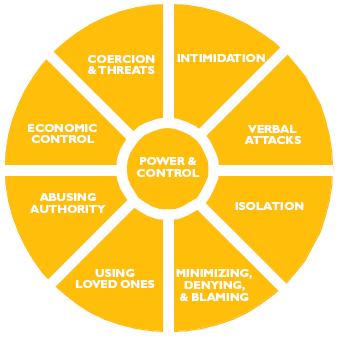 This wheel helps link the different behaviors that together form a pattern of violence. It shows the relationship as a whole - and how each seemingly unrelated behavior is an important part in an overall effort to control someone. This wheel helps link the different behaviors that together form a pattern of violence. It shows the relationship as a whole - and how each seemingly unrelated behavior is an important part in an overall effort to control someone.
Cycle of Domestic Violence
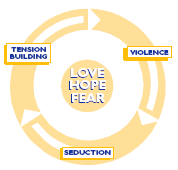 Battering is the establishment of control and fear in a relationship through violence and a series of behaviors, including intimidation, threats, psychological abuse, isolation, etc., to coerce and to control the other person. The violence may not happen often, but it remains as a hidden (and constant) terrorizing factor (Common Purpose, Inc., Jamaica Plain, MA). Battering is the establishment of control and fear in a relationship through violence and a series of behaviors, including intimidation, threats, psychological abuse, isolation, etc., to coerce and to control the other person. The violence may not happen often, but it remains as a hidden (and constant) terrorizing factor (Common Purpose, Inc., Jamaica Plain, MA).
The following components of the cycle of violence may be experienced by someone in an abusive relationship.
TENSION-BUILDING PHASE
criticism, yelling, swearing, using angry gestures, coercion, threats
VIOLENCE PHASE
physical and sexual attacks and threats
SEDUCTION PHASE
apologies, blaming, promises to change, gifts
LOVE / HOPE / FEAR
These three dynamics keep the cycle in motion and make it hard to end a violent relationship.
Love for your partner, the relationship has its good points, it’s not all bad.
Hope that it will change, the relationship didn’t begin like this.
Fear that the threats to kill you or your family will become a reality.
- Top -
Non-Violence Wheel
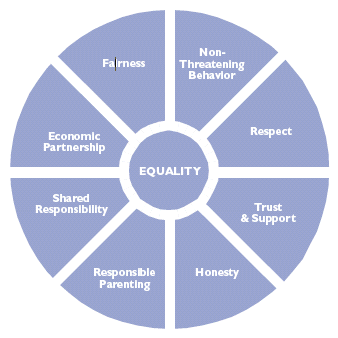 The Non-Violence Wheel offers a view of a relationship that is based on equality and non violence. Use this chart to compare all of the characteristics The Non-Violence Wheel offers a view of a relationship that is based on equality and non violence. Use this chart to compare all of the characteristics
of a non-violent relationship to those of an abusive relationship. The Non-Violence Wheel is also helpful in setting goals and boundaries in personal relationships.
Suggestions for Helping
Do you know someone in a violent relationship? Do you suspect that a friend, relative, or someone you know is being abused? If so, don't be afraid to offer help - you just might save someone's life. Here are some basic steps you can take to assist someone who may be a target of domestic violence:
Approach your friend in an understanding non-blaming way. Tell her/him that s/he is not alone, that there are people like her/him in the same kind of situation, and that it takes strength to survive and trust someone enough to talk about the abuse.
Acknowledge that it is scary and difficult to talk about domestic violence. Tell this person that s/he doesn't deserve to be threatened, hit, or beaten. Nothing a person can do or say makes the abuser's violence OK.
Share information. Show your friend the Warning List, Violence and Non-Violence Wheels. Discuss the dynamics of violence and how abuse is based on power and control.
Support this person as a friend. Be a good listener. Encourage the person to express her/his hurt and anger. Allow the person to make her/his own decision, even if it means not being ready to leave the abusive relationship.
Ask if your friend has suffered physical harm. Go with her/him to the hospital to check for injuries. Help report the assault to the police, if s/he chooses to do so.
Provide information on help available to battered women, men, and their children, including social services, emergency shelter, counseling services, and legal advice. To find this information, start with the resources listed in this handbook and local listings in the Yellow Pages under Social and Human Services.
Inform your friend about legal protection that is available in most states under abuse prevention laws. Go with her/him to district, probate, or superior court to get a protective order to prevent further harassment by the abuser. If you can't go, find someone who can.
Plan safe strategies for leaving an abusive relationship. These are often called “Safety Plans.” Never encourage someone to follow a safety plan that the person believes will put her/him at further risk. And remember that your friend may not feel comfortable taking these materials with her/him.
- Top -
Personalized Safety Plan
Suggestions for increasing safety - In the relationship
- I will have important phone numbers available to my children and myself.
- I can tell ___________________ and ___________________ about the violence and ask them to call the police if they hear suspicious noises coming from my home.
- If I leave my home, I can go (list four places): ___________________, _____________________________, __________________________, or _____________________________.
- I can leave extra money, car keys, clothes, and copies of documents with _________________________.
- If I leave, I will bring _________________________________________________.
- To ensure safety and independence, I can: keep change for phone calls with me at all times, open my own savings account, rehearse my escape route with a support person, and review my safety plan on ___________________ (date).
Suggestions for increasing safety - When the relationship is over
- I can: change the locks; install steel/metal doors, a security system, smoke detectors and an outside lighting system.
- I will inform _________________ and ___________________ that my partner no longer lives with me and ask them to call the police if s/he is observed near my home or my children.
- I will tell people who take care of my children the names of those who have permission to pick them up. The people who have permission are __________________________, ___________________________ and _____________________________.
- I can tell ___________________ at work about my situation and ask ______________ to screen my calls.
- I can avoid stores, banks, and __________________________ that I used when living with my battering partner.
- I can obtain a protective order from _________________________. I can keep it on or near me at all times as well as leave a copy with _____________________________.
- If I feel down and ready to return to a potentially abusive situation, I can call _____________________ for support or attend workshops and support groups to gain support and strengthen my relationships with other people.
- If I have animals I can leave them with ___________ or _____________.
Important Phone Numbers
Police: 911
Hotline: (800) 799-SAFE ext. 7233
_____________________________
_____________________________
_____________________________
_____________________________
Items to Take Checklist - FOR PRINTABLE VERSION CLICK HERE
- Identification
- Birth certificates for me and my children
- Social Security cards
- School and medical records
- Money, bankbooks, credit cards
- Keys - house/car/office
- Driver's license and registration
- Medications
- Change of clothes
- Welfare identification
- Passport(s), Green Card(s), work permits
- Divorce papers
- Lease/rental agreement, house deed
- Mortgage payment book, current unpaid bills
- Insurance papers
- Address book
- Pictures, jewelry, items of sentimental value
- Children's favorite toys and/or blankets
- Top -
|